





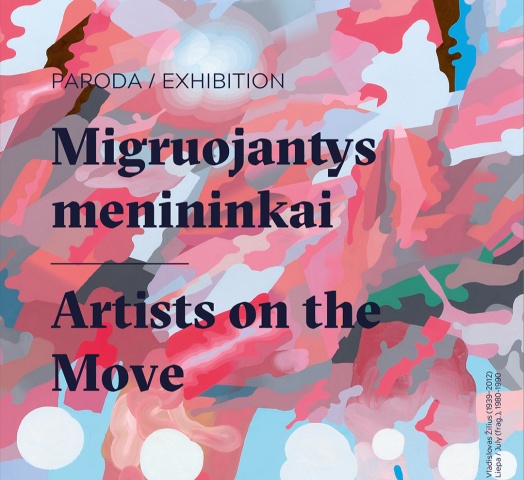
We invite you on a retrospective journey through nine decades of the twentieth century, following the traces of Lithuanian artists far beyond the borders of their homeland.
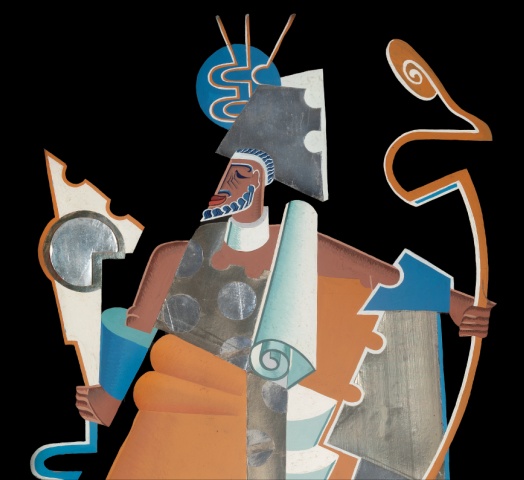
The exhibition ‘Stasys Ušinskas: The Iceberg of Lithuanian Modernism’ at the Museum of Applied Arts and Design.

In the TARTLE exhibition ‘Solely Saints’, we welcome you to explore depictions of saints spanning from the 16th century to contemporary times.

Celebrate the 150th anniversary of the birth of Mikalojus Konstantinas Čiurlionis, Lithuania’s most famous composer and Symbolist painter!

Exhibition opening at 5.30 pm on Wednesday, 5 March 2025 at Vilnius Picture Gallery of the LNMA (Didžioji 4, Vilnius).
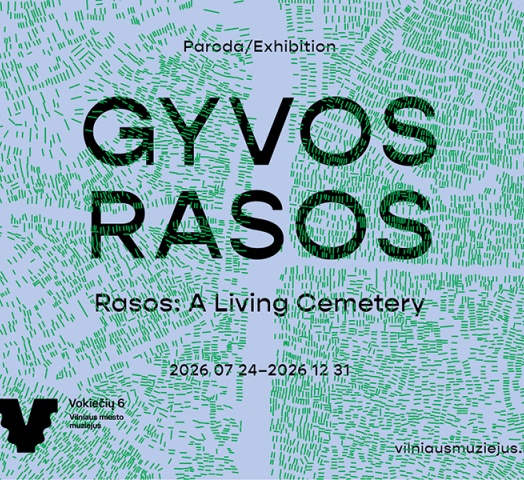
The exhibition “Rasos: A Living Cemetery“ at the Vilnius City Museum (Vokiečių St. 6) covers the period from the cemetery’s establishment to the end of the Second World War. It tells about its establishment and development, the gravestones and their symbolism, and some of the people who found their final resting place there. It also presents some of its current inhabitants. We invite you to remember, explore and help preserve this fragile habitat of memory and biodiversity. A work by Jerzy Hoppen from the TARTLE collection was lent to this exhibition.
Founded in 1801, the Rasos Cemetery is the oldest surviving cemetery in Vilnius. New European urban development regulations stipulated that cemeteries should be located in areas clearly separated from the city. These regulations also took effect in the Russian Empire. Rasos was the first “modern” cemetery, not only in Vilnius but in Lithuania as a whole, laid out by the Imperial authorities beyond the city limits, away from any parish church, on an undeveloped hilly site.

The exhibition, currently open at Zuzeum Art Centre in Riga, focuses on the works of three Baltic women artists – Malle Leis (1940–2017), Maija Tabaka (1939) and Marija Teresė Rožanskaitė (1933–2007) – in the late Soviet era of the 1970s and 1980s. All three of the artists challenged contemporary art discourses through non-conventional approaches to self-representation, ways of creating space and reflections on being artists. TARTLE has lent the artwork \"The Birth\" (1983) and \"Yellow Draperies\" (1991) by Marija Teresė Rožanskaitė for the exhibition.The exhibition focuses on the works of three Baltic women artists – Malle Leis (1940–2017), Maija Tabaka (1939) and Marija Teresė Rožanskaitė (1933–2007) – in the late Soviet era of the 1970s and 1980s. All three of the artists challenged contemporary art discourses through non-conventional approaches to self-representation, ways of creating space and reflections on being artists. TARTLE has lent the artwork \"The Birth\" (1983) and \"Yellow Draperies\" (1991) by Marija Teresė Rožanskaitė for the exhibition.

The exhibition \"Iron Vilnius\" opens at the Museum of Applied Arts and Design. Through a unique dialogue between the city\'s history and contemporary art, the beauty and importance of iron will be revealed to visitors. \"Iron Vilnius\" will invite you to take a new look at iron - both as a witness to the city\'s history and as a source of creative inspiration. The exhibition \"Iron Vilnius\" will be open until March 16. The exhibition includes Teodoras Kazimieras Valaitis\' \"Weathervane\" (1972) from the TARTLE collection.

On November 14th at the MO museum, exhibition Longing, Not Sure What For was opened. TARTLE has lent the artwork \"Thunder\" (before 1931) by Juozas Mikėnas for the exhibition.

Albinas Elskus (1926–2007) was a stained-glass artist, painter, dedicated educator, an inspired essayist, and a passionate sailor.