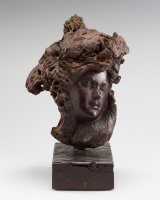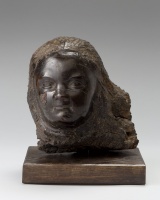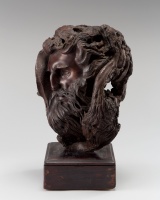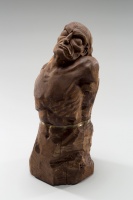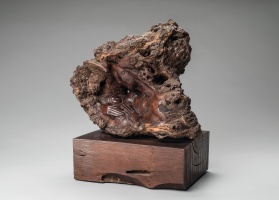


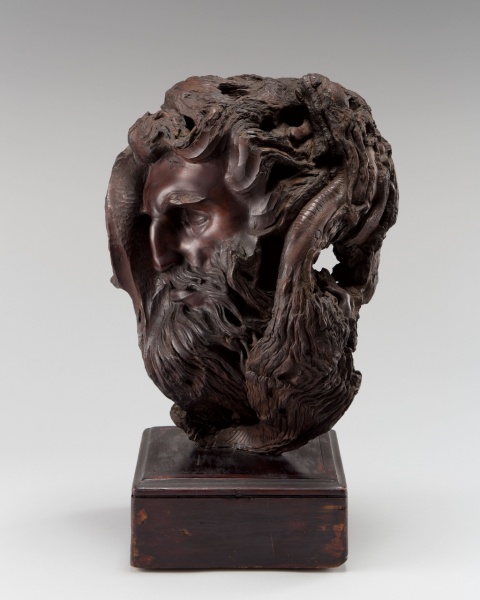

Head of a Man
| Author: |
Matas Menčinskas (1897–1942) |
| Created: | 1929-1934 |
| Material: | wood |
| Dimensions: | 46 × 35 cm |

Matas Menčinskas (1897–1942), a sculptor who worked in Lithuania in the interwar years, stood out clearly with his original style. He enrolled at Kaunas Art School in 1922 before the sculpture studio opened there, and soon started to look for opportunities to study abroad. He eventually went to Barcelona, Madrid and Buenos Aires, where he became interested in the work of Stepan Erzia, a sculptor of Mordovian origin, which had a direct influence on his style and on his choice of material (such as quebracho wood). Menčinskas began carving symbolic compositions and sculptures, mostly busts. Financial hardship and failing health made him return to Lithuania in 1934. His unusual pieces carved out of wood are distinguished by their technical skill and expressive power, which were untypical of local sculptors in the 1930s, who worked mainly in clay, gypsum and bronze. However, he did not avoid the influence of Art Deco either, and created figures in Neoclassical forms, as well as high-quality salon-style compositions in gypsum.
Text authors Dovilė Barcytė and Ieva Burbaitė
The art historian and collector Beatričė Kleizaitė-Vasaris, who lived in Buenos Aires for a time, saw this sculpture, and it stayed etched in her memory for the rest of her life. With his thick beard and hair flowing in picturesque curls, the figure reminded her of the fiery biblical prophet Moses. While this association is personal and subjective, the composition itself is undeniably dramatic. Head of a Man, emerging from the elemental chaos of nature, attests to Menčinskas’ technical ability. While living in Argentina, he honed his skills in the workshop of a fellow émigré, the Russian sculptor Stepan Nefyodov-Erzia, who had been invited there by President Marcelo Torcuato de Alvear. That was when he chose to work with quebracho, an exceptionally hard wood previously unknown in artistic works. He transformed discarded tree stumps from road and railway construction sites, turning this industrial material into refined modernist sculptures. By skilfully combining the natural texture of the roots and branches with polished and luxuriously shiny surfaces, Menčinskas created busts that are both evocative and powerfully expressive.
Text author Laura Petrauskaitė
Source: Law firm Valiunas Ellex art album KAUNAS–VILNIUS / 1918–1945 (2021). Compilers and text authors Dovilė Barcytė and Ieva Burbaitė, THE ART OF MATERIALS (2024). Compiler and text author Jurgita LudavičienėExpositions: "A Glance at the History of Lithuanian Art from Užupis", 30 August 2018 – 1 June 2019, Lithuanian Art Centre TARTLE (Užupio St. 40, Vilnius). Curator Giedrė Jankevičiūtė; "Artists on the Move", 28 May 2026 – 1 May 2027, Lithuanian Art Centre TARTLE (Užupio St. 40, Vilnius). Curators Rasa Žukienė, Ieva Burbaitė, Emilija Vanagaitė.