

The Opposite
| Author: |
Elena Kepalas (1920–2006) |
| Created: | 1950s |
| Material: | bronze |
| Dimensions: | 28 × 16.50 cm |

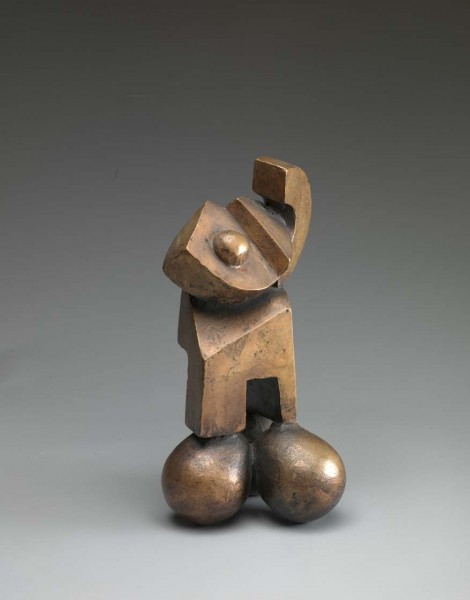
Elena Kepalas (1920–2006) began her career as a professional ballerina, initially moving to Germany after the war, and later settling in Australia. She subsequently made her home in Toronto in Canada, where she studied sculpture at the Ontario College of Art. In 1961 she relocated to New York, where she honed her skills in bronze casting at the Brooklyn Museum Art School. The art researcher Elona Lubytė employs Algirdas Julius Greimas’ concept of ‘the noble style’ to describe the artistic approach of Kepalas and other émigré artists of her generation. He characterised ‘the noble style’ as a ‘refusal to commit’,* embraced by artists for whom individual self-expression reigns supreme. Kepalas once claimed that dancing served as a bridge to the world of sculpture. Her body of work is marked by generalised forms and the quest to discover the most concise visual language to convey ideas. The influence of Cubism is discernible in her formal language. During her time in New York, she had the opportunity to interact with Jacques Lipchitz, a prominent Cubist sculptor, who provided guidance and feedback on her first works. The bronze sculpture The Opposite presents an abstracted human figure, apparently constructed from disparate parts. However, as the title suggests, it serves more as a study in the juxtaposition of angular and sleek abstract forms.
Text author Jurgita Ludavičienė
* Išeivijos dailė. Vilnius, 2003, p. 196.
While living in Lithuania, Elena Kepalas (1920–2006) studied Classical ballet and performed in opera productions in Vilnius during the difficult years of the Second World War. On 21 April 1944, she appeared in the première performance of the Vilnius Ballet Company, which featured Riccardo Drigo’s one-act ballet The Magic Flute, Carl Maria von Weber’s Invitation to Dance, and other pieces (Vytautė Markeliūnienė, ‘Baletas Vilniaus operoje (1941–1944)’ [Ballet in the Vilnius Opera (1941–1944)], Krantai, 2010, No 137, p. 41). However, Kepalaitė was forced to leave her home town that summer. She encountered Expressionist dance for the first time after moving to Germany, where she studied in Augsburg under Walter Klass, a former student of the pioneer of modern dance Mary Wigman. On emigrating to Australia, she later continued her training with Hanny Kolm, and with Danutė Nasvytytė, a key figure in the development of Lithuanian Expressionist dance. The visual arts came to play a central role in Kepalas’ creative life, alongside her dedication to modern dance. She studied painting in Australia, and after moving to North America she studied sculpture at Ontario College of Art and the Brooklyn Museum Art School. Her sculpture The Opposite reflects her admiration for early 20th-century European avant-garde sculpture. This aesthetic direction was further encouraged by her acquaintance with the renowned Cubist Jacques Lipchitz, who had settled in New York during the war.
Text author Laura Petrauskaitė
Source: Law firm Valiunas Ellex art album THE ART OF MATERIALS (2024). Compiler and text author Jurgita Ludavičienė, ARTISTS ON THE MOVE (2025). Compiler and text author Laura PetrauskaitėExpositions: "Free and Unfree. Lithuanian Art between 1945 and 1990", 9 September 2021 – 30 April 2022, Lithuanian Art Centre TARTLE (Užupio St. 40, Vilnius). Curators Dovilė Barcytė and Ieva Burbaitė; "In The Shadow of Knowledge", 5 June 2025 – 1 May 2026, Lithuanian Art Centre TARTLE (Užupio St. 40, Vilnius). Curator Jurgita Ludavičienė.