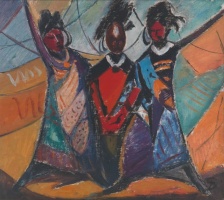
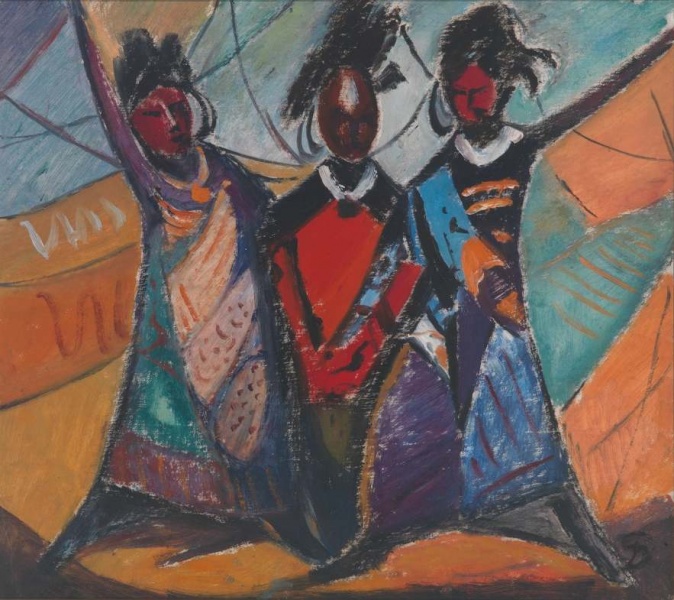

Three African Figures
| Author: |
Franz Domscheit (1880–1965) ![]() |
| Created: | 1952 |
| Material: | cardboard |
| Technique: | oil |
| Dimensions: | 52 × 62 cm |
Several versions of this composition are known to exist in public and private collections. The original title of the painting, Basuto Dancers, refers to an ethnic group in Lesotho and the Republic of South Africa, highlighting their folk traditions. The canvas in the collection has a more abstract title, Three African Figures, which serves to obscure the anthropological gaze of the artist. The work was created three years after Domšaitis settled in South Africa, during a period when the government was enforcing the policy of apartheid. Under the regime, black South Africans, who constituted about 80 per cent of the population, were stripped of political and civil rights. More than half were forcibly relocated to reservations, while those remaining in the cities were subjected to strict segregation laws. In response to these circumstances, Domšaitis chose not to confront the harsh social realities of the time. Instead, he directed his gaze towards the ‘neutral’ natural environment and the colourful folklore of the region. In line with the German Expressionists who influenced him, he took an interest in the indigenous peoples of Africa, such as the Basotho, Zulus and Khoisans. He visited reservations and sought to capture what he saw as ‘primitivism’ in the people living there, creating an idealised portrayal of South African villages and their inhabitants. We do not find any references to the damage wrought by apartheid on the Republic of South Africa in his work.
Text author Laura Petrauskaitė
Source: Law firm Valiunas Ellex art album ARTISTS ON THE MOVE (2025). Compiler and text author Laura PetrauskaitėExpositions: “Always on the Road. Paintings from Private Collections”, 12 June – 27 July 2015, M. Žilinskas Art Gallery, Kaunas