

Statuary
| Author: |
Samuel Bak (b. 1933)  |
| Created: | 2001 |
| Material: | canvas |
| Technique: | oil |
| Dimensions: | 62 × 47 cm |
| Signature: | unsigned |

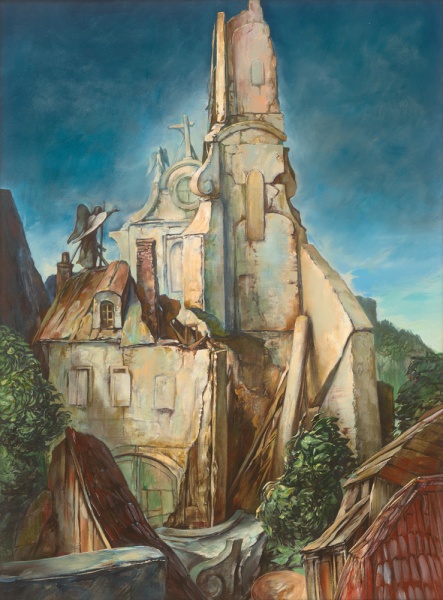
In 2001, Samuel Bak (b. 1933) returned to his home town, attended the opening of a solo exhibition at the Lithuanian Art Museum, and painted a series of pictures called ‘Returning Home’. Statuary is one of the pictures in this series. He draws on Surrealism in his work, and adapts realistic forms of expression in order to create an unrealistic and nightmarish atmosphere. It is not a picture of a place in Vilnius with actual buildings, but a vision of the demolished city, symbolised by the ruins of a Baroque church, a tower and houses. The town of the artist’s happy childhood is gone, turned into ruins, which rise vertically like a statue and a monument to the victims of the Holocaust.
Text author Laima Laučkaitė
The longing for lost Vilnius. The Second World War and the Holocaust destroyed the rich Litvak world, and the fate of the Jerusalem of Lithuania echoed the fate of old Jerusalem: it turned into a ruin and a place of mourning. However, not all artists could accept the loss of the Jerusalem of Lithuania, a symbol of the traditions and the longevity of the Jewish community. Images of the city before the war remained in the hearts and minds of the Vilnius residents Rafael Chwoles and Samuel Bak, despite being filled with tragic overtones. Their work became a requiem for the lost city and its old way of life.
Rafael Chwoles survived the Holocaust through luck, but the tragedy claimed the lives of his parents and three of his five sisters. The artist left Soviet Lithuania, settled in Warsaw, and later moved to Paris; but he kept returning in his work to a city where the Great Synagogue was still standing and the Jewish quarter was bustling with activity.
After moving to the USA, Samuel Bak developed clear rules of composition and proportion based on images of his home town. He once said in an interview: ‘I have been drawing Vilnius in one way or another all my life. I saw Vilnius as a child, and I am still guided by those impressions in my work, by the proportions of the windows and the walls, among the houses and the streets’ (Samuel Bak, 2001, Lietuvos rytas, 224:8). The shadow of death that passed over Bak’s family
in his childhood hovers over the ruins of his abandoned cities to this day (only he and his mother survived, his father and his four grandparents died).
Text author Vilma Gradinskaitė
Source: Law firm Valiunas Ellex art album VILNIUS. TOPOPHILIA I (2014). Compiler and author Laima Laučkaitė, STORIES OF LITVAK ART (2023). Compiler and author Vilma Gradinskaitė