





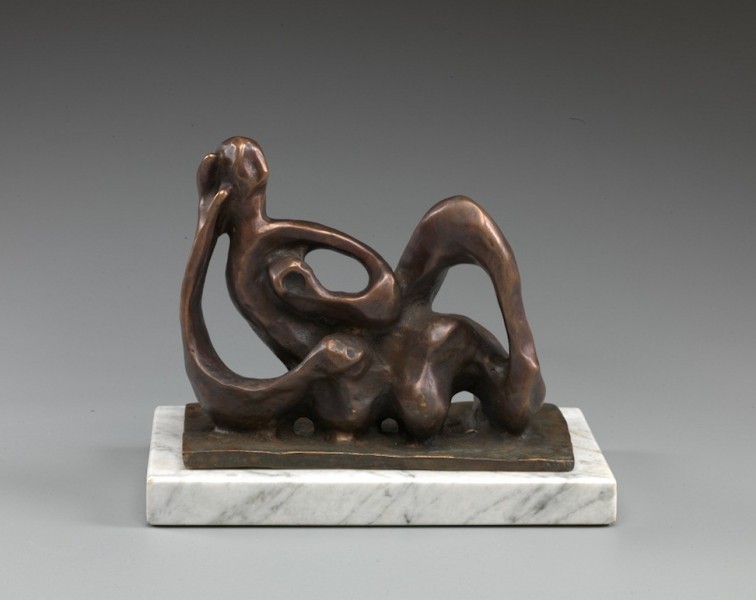

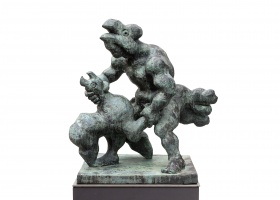
Hagar I (study)
| Author: |
Jacques Lipchitz (1891–1973)  |
| Created: | 1948 |
| Material: | bronze |
| Dimensions: | 13.50 × 8.30 cm |
| Signature: | on the pedestal: 5/2 Jlipchitz |

This sculpture is part of a series based on the Old Testament figure of Hagar, the Egyptian maidservant who bore Abraham’s son Ishmael. When Sarah, who had been barren for many years, finally gave birth to her own child, Isaac, she and Abraham sent Hagar and Ishmael into the wilderness. Lost and despairing, exhausted and thirsty, Hagar heard the voice of an angel, and found a well that saved her. This tale of betrayal, protection and displacement has an immense significance in the origins of Judaism. For Jacques Lipchitz (1891–1973), a Jewish sculptor who was himself forced to flee from Europe and found refuge in America, where he married for the second time, the story of Hagar probably resonated deeply. The timing of his exploration of the theme is significant: he began to work on this subject in 1948 during the Arab-Israeli war. In his autobiography, he describes the theme of Hagar as ‘a prayer for Jewish-Arab brotherhood’. Throughout the late 1940s, he explored the theme of Hagar across various media, including plaster, bronze and drawing. Each piece in the series conveys a sense of tragedy mingled with hope.
Text author Jurgita Ludavičienė
Born in Druskininkai, Jacques Lipchitz was already an internationally acclaimed artist when his sculpture Hagar was presented at the first São Paulo Biennial in 1951. He began exploring the biblical story of Hagar in the 1940s, producing several sculptural interpretations of the theme, one of which is now in the collection. These works were shaped by the events of the 1948 Palestine War and Lipchitz’s deep empathy for both sides in the conflict. As he explained: ‘Despite my admiration for and love of Israel, I feel strongly that the Jews and the Arabs should make peace, that they should live together as brothers [...] I wished to show my sympathy for [Hagar’s son] Ishmael, who is thought of as the father of the Arabs in the same manner as the Hebrews are the sons of Abraham; so this is a prayer for brotherhood between the Jews and the Arabs. It is a concept which combines tragedy and suffering with tenderness and hope for the future’ (Jacques Lipchitz, with Harvard H. Arnason, My Life in Sculpture, New York: Viking Press, 1972, pp. 183–184). The story of Hagar and Ishmael probably had a personal significance for Lipchitz. The Egyptian maidservant, cast out of Abraham’s household and forced to wander through the desert with her son, faced an existential threat, a biblical narrative that echoed Lipchitz’s own perilous experiences as a Jewish artist fleeing Nazi-occupied Europe during the Second World War.
Text author Laura Petrauskaitė
Source: Law firm Valiunas Ellex art album MORE THAN JUST BEAUTY (2012). Compiler and author Giedrė Jankevičiūtė, THE ART OF MATERIALS (2024). Compiler and text author Jurgita Ludavičienė, ARTISTS ON THE MOVE (2025). Compiler and text author Laura PetrauskaitėExpositions: “More Than Just Beauty: The Image of Woman in the LAWIN collection”, 12 October – 11 November 2012, National Gallery of Art, Vilnius; “Life in Sculpture. Jacques Lipchitz – 125”, 1 July –25 September 2016, The Tolerance Centre of the Vilna Gaon State Jewish Museum, Vilnius; "In The Shadow of Knowledge", 5 June 2025 – 1 May 2026, Lithuanian Art Centre TARTLE (Užupio St. 40, Vilnius). Curator Jurgita Ludavičienė.
_web.jpg)