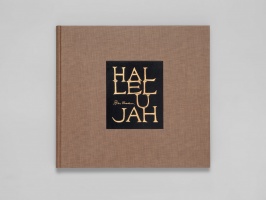


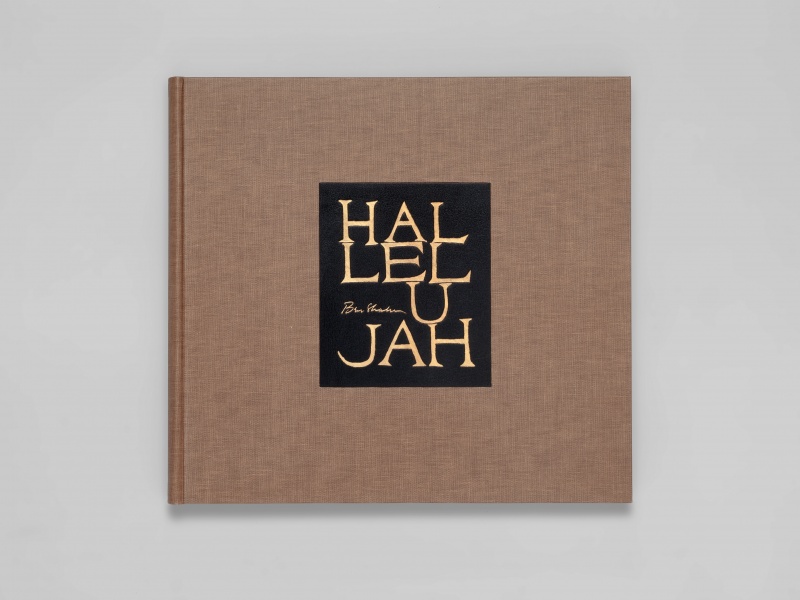

Hallelujah. Series of 24 lithographs
| Author: |
Ben Shahn (1898–1969)  |
| Created: | 1970-1971 |
| Material: | paper |
| Technique: | litograph |
| Dimensions: | 45.72 × 48.26 cm |

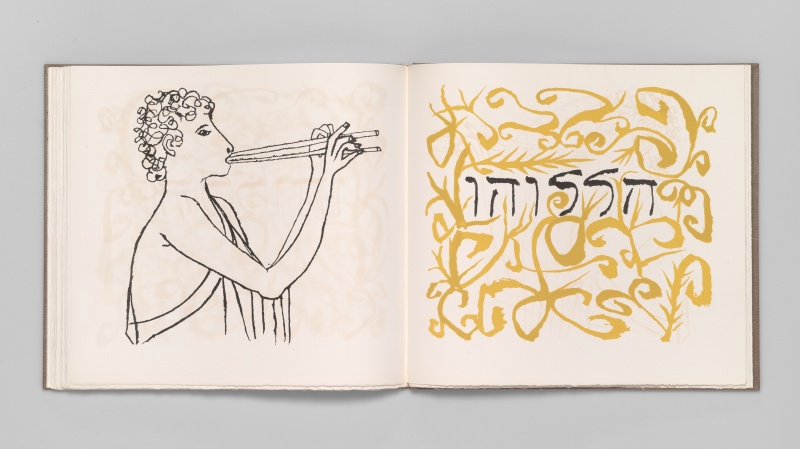
Ben Shahn (1898–1969) described his childhood in the shtetl of Ukmergė as follows: ‘At that time I went to school for nine hours a day, and all nine hours were devoted to learning the true history of things, which was the Bible; to lettering its words, to learning its prayers and its psalms, which were my first music, my first memorized verse. Time was to me then, in some curious way, timeless. All the events of the Bible were, relatively, part of the present. Abraham, Isaac, and Jacob were “our” parents – certainly my mother’s and father’s, my grandmother’s and my grandfather’s, but mine as well. I had no sense of imminent time and time’s passing ...’ (Frances Katheryn Pohl, Ben Shahn, San Francisco: Pomegranate Artbooks, 1993, p. 8). At the age of eight, Shahn emigrated with his family to the United States, where he was introduced to a modern concept of historical time, which he gradually adopted. But the experience of the ‘eternal now’ remained with him throughout his life, and he returned to it in his own way when creating a livre d’artiste, In the limited-edition album Hallelujah, Shahn wrote out Psalm 150 by hand and accompanied it with illustrations of the ram’s horn (shofar) blown on special holidays, the cymbals and other biblical instruments. This joyful psalm, still recited today by Jews and Christians around the world, calls upon all living beings to join together in praise:
Hallelujah Praise God In His Sanctuary
Praise Him In the Firmament of His Power
Praise Him For His Mighty Acts
Praise Him According to His Abundant Greatness
Praise Him With the Blast of the Horn
Praise Him With the Psaltery and Harp
Praise Him With the Timbrel and Dance
Praise Him With Stringed Instruments and the Pipe
Praise Him With the Loud-Sounding Cymbals
Praise Him With the Clanging Cymbals
Let Every Thing that Hath Breath Praise the Lord
Praise Him HALLELUJAH
Text author Laura Petrauskaitė
The Tanakh and the psalms. The Old Testament (in Hebrew TaNaK) was created in the 12th to the second centuries BC. The Tanakh consists of 38 books divided into three parts: the Torah, i.e., the Pentateuch of Moses, or the Books of the Law (T), Neviim, the Books of the Prophets, which contain various narratives (N), and Ketuvim, the Books of Writings, a source of popular wisdom, proverbs and psalms (K). There are 150 psalms praising various attributes of God. In the last years of his life, the artist Ben Shahn, who is famous for his political works, began to seek inspiration in the Old Testament. Shortly before his death in 1969, inspired by the Psalms, he made 24 lithographs. The series of lithographs Hallelujah (in Hebrew Hallelu-Jah, in Greek and Latin Alleluia, ‘Praise the Lord’) was published in an edition of 240 numbered copies in 1970– 1971 after the artist’s death in 1969. The TARTLE collection has number nine.
In the lithographs, Shahn depicted various types of instruments mentioned in the Old Testament that were used to praise God in the Temple, as stated in the 150th, the last, of the Psalms: ‘Praise ye the Lord. / Praise God in his sanctuary: / Praise him in the firmament of his power. / Praise him for his mighty acts: / Praise him according to his excellent greatness. / Praise him with the sound of the trumpet: / Praise him with the psaltery and harp. / Praise him with the timbrel and dance: / Praise him with stringed instruments and organs. / Praise him upon the loud cymbals: / Praise him upon the high-sounding cymbals. / Let every thing that hath breath / Praise the Lord!’ (Psalm 150, 1–6).
Text author Vilma Gradinskaitė
© Estate of Ben Shahn (VAGA) / LATGA, Vilnius
Source: Law firm Valiunas Ellex art album STORIES OF LITVAK ART (2023). Compiler and author Vilma Gradinskaitė© LATGA, Vilnius 2026