


Futurity Island
| Authors: |
Nomeda Urbonienė (1968) Gediminas Urbonas (1966) |
| Created: | 2018 |
| Material: | sound transducers, PVC pipes |
| Dimensions: | 420 × 680 cm |

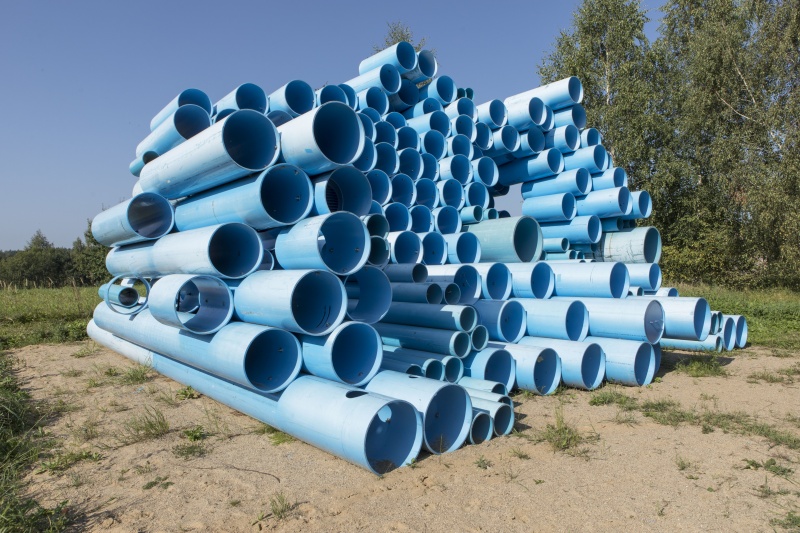
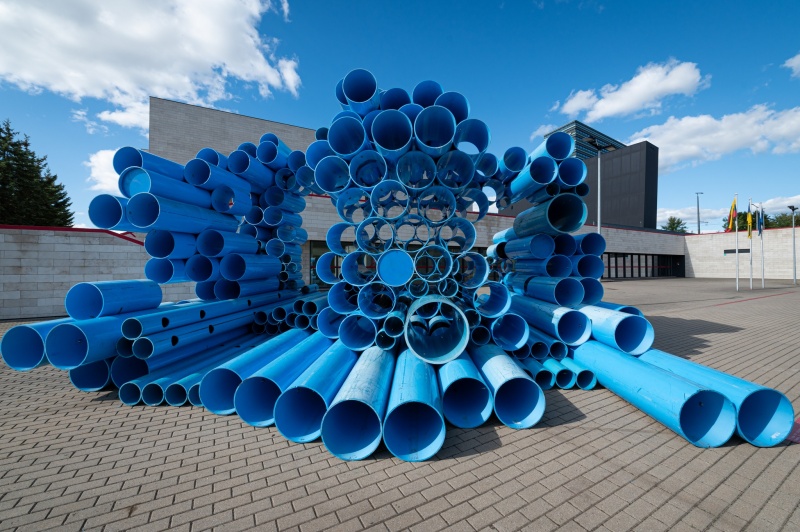
After settling in Cambridge, USA, and beginning to teach at the Massachusetts Institute of Technology, Nomeda (b. 1968) and Gediminas (b. 1966) Urbonas moved into a modernist house designed by students of Walter Gropius, where they could feel relaxed and at home. But they do not shy away from critiquing the very phenomenon of modernity itself. According to Gediminas, their interest lies in contrasting the modernist pursuit of purity, which tends to reject any kind of hybridity, with the concept of sympoetics, a collaborative engagement with non-human species, drawing on their wisdom and modes of intelligence (cf. Lithuanian National Museum of Art and LRT video interview Conversations in the Museum. Nomeda and Gediminas Urbonas, 4 March 2024). The artist duo present Futurity Island as a platform for interspecies communication, giving a voice to the silenced life forms on our planet. This multifaceted installation combines water pipe architecture with a soundscape entitled Amphibian Songs, which translates environmental pollution data into sound, and integrates the underwater voices of caddisfly larvae and flute music. Through this work, the Urbonas invite us to open ourselves up to alternative ways of knowing and experiencing the world. However, critics have asked a few questions. Do the caddisfly larvae actually want to be heard, or would they rather remain undisturbed? If the project claims to be a symmetrical dialogue between human and non-human beings, why is authorship attributed solely to the Urbonas, and not to the caddisflies?
Futurity Island was first exhibited in Canada as part of the Black Woods Gallery project ‘The Work of Wind: Air, Land, Sea’. It was subsequently set up in Massachusetts Institute of Technology Square. It later moved to the approaches of the Pamario Gallery on the Curonian Spit, featured in the retrospective ‘Partially Swamped Institution’ at the National Gallery of Art in Vilnius, and finally appeared in the international Helsinki Biennial during the summer of 2025.
Text author Laura Petrauskaitė
Nomeda and Gediminas Urbonas (b. 1968 and 1966) are an artist duo who are consistently engaged in research-based artistic creation. Each of their works emerges from extensive, often long-term, research across various fields, seamlessly blending scientific and artistic endeavours. Having graduated from the Vilnius Academy of Art in different disciplines (Nomeda in graphic art, Gediminas in sculpture), they initially pursued solo careers. Gediminas was a founding member of the pioneering Žalias lapas (Green Leaf ) performance and action group in 1993. Together with the art researcher Saulius Grigoravičius, he established the Jutempus TMP (Interdisciplinary Art Projects) contemporary art gallery in what is now the Kablys venue. In 2007, the Urbonas represented Lithuania at the Venice Biennale with their interdisciplinary project Villa Lituania. This project can be viewed as an artistic exploration of the former Lithuanian Embassy building in Rome, which Lithuania lost after its occupation by the Soviet Union. Currently teaching at the Massachusetts Institute of Technology, the Urbonas focus predominantly on ecological themes in their work. Their installation Futurity Island exemplifies this interest. It serves as an object firing the imagination, a stage for performance, and a space for listening. At its core lies a large-diameter pipe, clearly crafted by human hands. Yet it transcends its industrial origins, which are typically associated with drainage, and oil and gas pipelines, as part of man’s exploitation of nature. In the Urbonas’ vision, the pipe transforms into a tool for listening to the sounds of nature, serving as a conduit to reveal its secrets. Futurity Island offers the hope of a harmonious coexistence between man and nature. Originally conceived as a floating laboratory for the Venice Biennale of Architecture, the installation debuted in 2018 at ‘The Work of Wind: Land, Air and Sea’ project organised by the University of Toronto. In 2019 it graced the square of the Massachusetts Institute of Technology campus, and in 2023 it was exhibited at the National Gallery of Art in Vilnius.
Text author Jurgita Ludavičienė
Photos by Gintarė Grigėnaitė and Antanas Lukšėnas
Source: Law firm Valiunas Ellex art album THE ART OF MATERIALS (2024). Compiler and text author Jurgita Ludavičienė, ARTISTS ON THE MOVE (2025). Compiler and text author Laura PetrauskaitėExpositions: “The Work of Wind, Air, Land, Sea”, 14-23 September 2018, Southdown Industrial area, Mississauga, Ontario, Canada. Curator Christine Shaw. /// 28 July – 31 August 2023. Exhibited next to Pamario Gallery, Juodkrantė. /// September – November 2023. Exhibited next to the National Gallery of Art, Vilnius; Helsinki Biennial 2025, 8 June – 21 September 2025, Helsinki, Finland. Curators Kati Kivinen and Blanca de la Torre; "In The Shadow of Knowledge", 5 June 2025 – 1 May 2026, Lithuanian Art Centre TARTLE (Užupio St. 40, Vilnius). Curator Jurgita Ludavičienė.
© VŠĮ „Lietuvos dailės fondas“