


Byzantium Furioso
| Author: |
Kęstutis Zapkus (b. 1938) |
| Created: | 1992–1995 |
| Material: | canvas |
| Technique: | oil |
| Dimensions: | 213 × 213 cm |

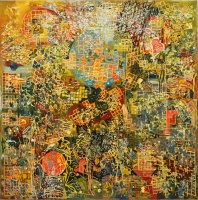
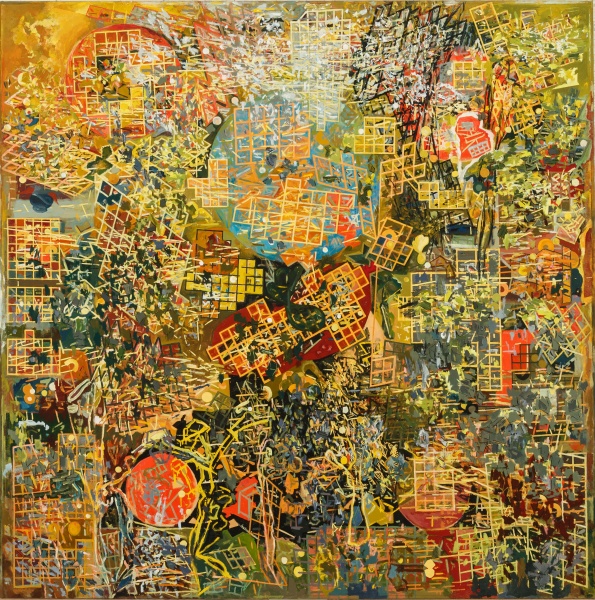
When the Second World War broke out, Kęstutis Zapkus was taken by his mother, who was born in the United States, to her homeland, while his father joined the partisans fighting in Lithuania. Other members of his family were unable to emigrate to the West. Earlier in the century, Zapkus’ grandfather, who had worked in the United States before returning to independent Lithuania, was hanged by the Soviets, while other family members were exiled to Siberia. The memory of communist persecution has remained a vivid and painful presence throughout his life. The artist felt deeply the destruction wrought upon Lithuania and its culture, and upon his family. During a visit to Moscow in 1989 he was struck by the lingering effects of years of totalitarian rule: the pervasive apathy, and the depressed, resigned obedience of the people. Seeking to understand why such oppression went largely unchallenged, he found a parallel in the atmosphere of obedience permeating the ancient Orthodox churches, their interiors darkened by centuries of smoke from candles. In these spaces of what he called ‘hysterical religious mysticism’, the ‘afterlife appeared as a dark stew, studded with flickers of gold and jewels, and twisted humanoid configurations’. These intuitive associations and insights, shaped by his experience in Moscow, are expressed vividly in the painting Byzantium Furioso. The work conveys a vision of sacralised, ‘bejewelled’ superstition shimmering amid a slimy, poisonous hellscape (cf. Kęstutis Zapkus, ‘Aspects of Content and Context. Notes on My Painting,’ Lituanus, 2007, Vol. 53, No 2, p. 44).
Text author Laura Petrauskaitė
Source: Law firm Valiunas Ellex art album ARTISTS ON THE MOVE (2025). Compiler and text author Laura PetrauskaitėExpositions: “Kęstutis Zapkus. A Retrospective of Painting”, 11 April – 1 June 2014, National Gallery of Art, Vilnius