





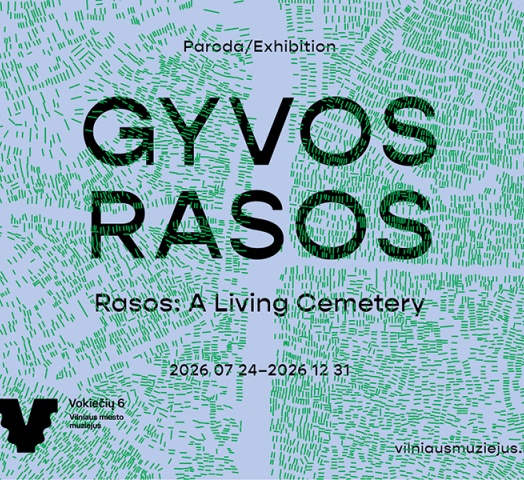
Exhibition "Rasos: A Living Cemetery" at the Vilnius City Museum
The exhibition 'Rasos: A Living Cemetery' at the Vilnius City Museum (Vokiečių St. 6) covers the period from the cemetery’s establishment to the end of the Second World War. It tells about its establishment and development, the gravestones and their symbolism, and some of the people who found their final resting place there. It also presents some of its current inhabitants. We invite you to remember, explore and help preserve this fragile habitat of memory and biodiversity. A work by Jurgis Hopenas from the TARTLE collection was lent to this exhibition.
Founded in 1801, the Rasos Cemetery is the oldest surviving cemetery in Vilnius. New European urban development regulations stipulated that cemeteries should be located in areas clearly separated from the city. These regulations also took effect in the Russian Empire. Rasos was the first “modern” cemetery, not only in Vilnius but in Lithuania as a whole, laid out by the Imperial authorities beyond the city limits, away from any parish church, on an undeveloped hilly site.
Before long, it became a pantheon of local Lithuanians, Poles and Belarusians, an architectural monument, a site for national and political demonstrations, and a unique green space within the city. The lives of plants, insects, fungi and birds continue unabated in the cemetery.