

Paris
| Author: |
Neemiya Arbitblatas (1908–1999)  |
| Created: | 1930s |
| Material: | canvas |
| Technique: | oil |
| Dimensions: | 73 × 91.50 cm |
| Signature: | bottom left: BLATAS |

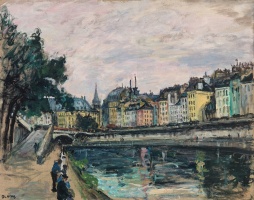
Parisian landscapes occupy a special place in the work of Arbit Blatas (1908–1999). Closely associated with the École de Paris, his paintings are distinguished by a style that is at once melancholic and animated. Paris was not simply a visually compelling subject for him, it was his spiritual home, to which he repeatedly returned in his imagery, depicting the banks of the Seine and the streets of Montmartre. Muted earthy tones, greys, blues, ochres and warm browns, prevail in this painting, through which the artist evokes the diffuse light of Paris, the atmosphere of a rainy day, and his own emotions. The palette is restrained, but the brushwork is bold and energetic, lending the scene a feeling of perpetual movement, and suggesting a city that is never absolutely still. Small human figures in the foreground reinforce this impression, embodying the ceaseless dynamic of metropolitan life.
Text author Rasa Žukienė
Although Arbit Blatas (1908–1999) did not study at Kaunas Art School, he brought new ideas to the Kaunas art scene. He never received a state scholarship, but studied art in Paris at his own expense at the Académie Julian and the Académie de la Grande Chaumiere, and so enjoyed much more freedom in his career. Following the Paris fashion, Blatas opened the first private art gallery in Kaunas, bringing the cultural life of the interim capital closer to the Western way of life. In 1932 and 1933, he put on exhibitions of works by young artists, both Lithuanians and other nationalities (mostly Jewish). He had to close the gallery due to a shortage of money, and left for Paris.
The works by Blatas in the collection can be said to summarise his career. His painting of the banks of the River Seine shows the strong influence of the Paris school.
Text authors Dovilė Barcytė and Ieva Burbaitė
French Expressionism and the École de Paris. In the early 20th century, every young person starting out on a career as an artist dreamt of going to Paris and becoming famous. The large group of Litvaks who migrated there formed the nucleus of the École de Paris. Litvak artists brought Yiddish culture and the shtetl world-view to Paris, which combined with the modern art trends of the time (Post-Impressionism, Cubism, Futurism and Fauvism) and formed a new trend, French Expressionism. This trend was popular between 1915 and 1940, and about 60 Litvaks and more than 150 Jewish painters from all over Europe were adherents of the Paris school.
French Expressionism brought fresh ideas, new motifs and artistic discoveries to art. The trend is characterised by elegance and restrained expression, flat forms, vibrant brushstrokes, light colours, and nuanced painting. The artists were interested in the life around them: views of the city and its squares, people enjoying themselves in cafés, the hustle and bustle of a market, and the razzle-dazzle of carousels and the circus. They painted portraits of their wives and children, streetwalkers and female nudes in studios, apples on windowsills, and flowers in vases.
Text author Vilma Gradinskaitė
Source: Law firm Valiunas Ellex art album THE WORLD OF LANDSCAPES II (2013). Compiler and author Nijolė Tumėnienė, KAUNAS–VILNIUS / 1918–1945 (2021). Compilers and text authors Dovilė Barcytė and Ieva Burbaitė, STORIES OF LITVAK ART (2023). Compiler and author Vilma Gradinskaitė, ARTISTS ON THE MOVE (2025). Compiler and text author Laura Petrauskaitė, DESTINED TO WANDER (2026). Compiler and text author Rasa ŽukienėExpositions: "1918-1945 / Kaunas-Vilnius", 27 August 2020 – 21 August 2021, Lithuanian Art Centre TARTLE (Užupio St. 40, Vilnius). Curators Dovilė Barcytė and Ieva Burbaitė; "Litvak Artists in Paris", 25 January 2024 – 3 June, Chaimas Frenkelis Villa-Museum, Šiauliai (curator Vilma Gradinskaitė); "Artists on the Move", 28 May 2026 – 1 May 2027, Lithuanian Art Centre TARTLE (Užupio St. 40, Vilnius). Curators Rasa Žukienė, Ieva Burbaitė, Emilija Vanagaitė.